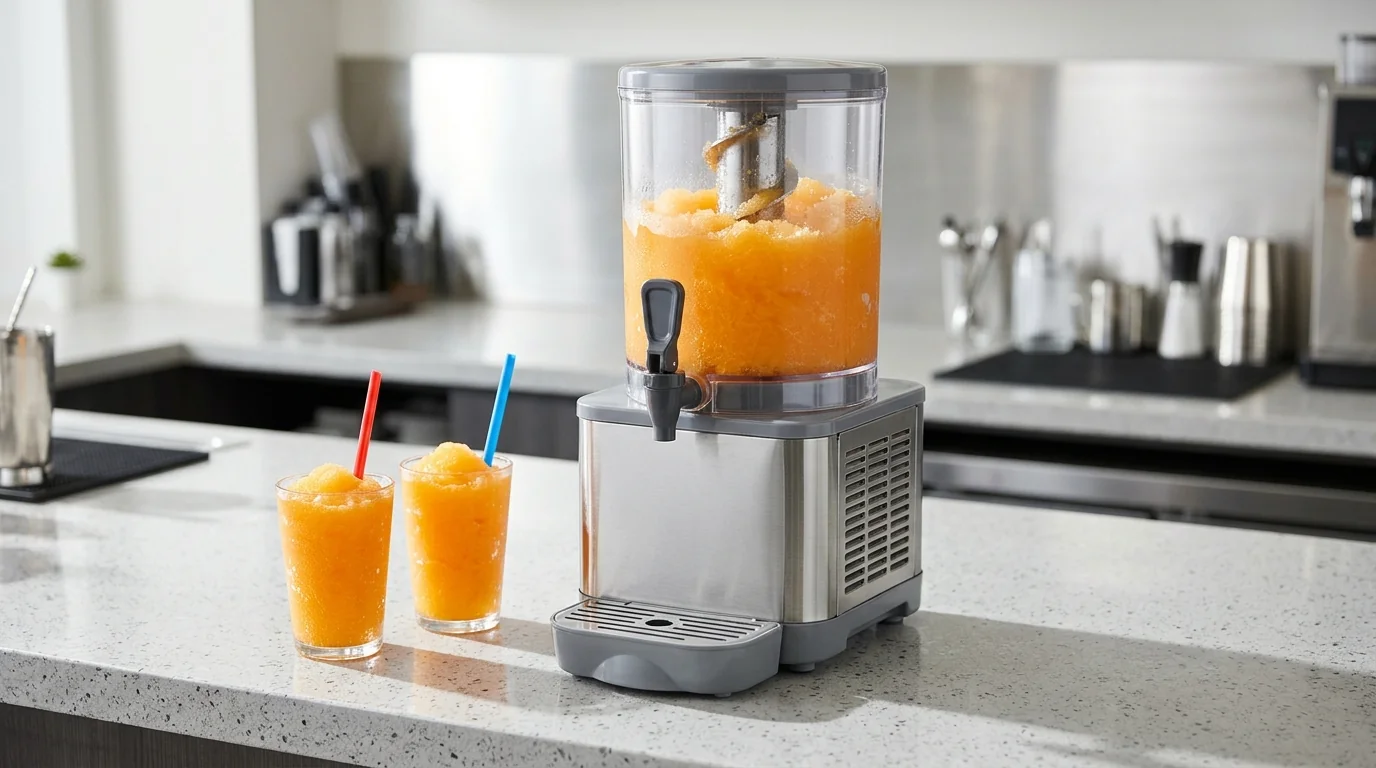
Quick Answer: What Is the Difference Between a Slush and a Frozen Drink?
In beverage equipment sourcing, 'frozen drink' is the broad umbrella category covering all semi-frozen beverages, while 'slush' (or slushy) is a specific water-and-sugar crystalline beverage within that family. A classic slush uses a clear sugar-syrup or fruit-juice base (12 to 16 Brix) churned into fine suspended ice crystals. Other frozen drinks vary widely in formulation and texture—including coarse flaky Italian granitas, alcohol-bearing frozen margaritas and daiquiris, and creamy dairy- or coffee-based frappes and smoothies. Selecting the right countertop machine depends on matching tank agitation and temperature modes to those target beverage recipes.
Slush vs. Frozen Drink: How the Umbrella Category Splits by Formulation and Texture
When retail buyers, cafe chains, and appliance distributors search for a 'frozen drink machine' vs. a 'slush machine,' they are often looking at the same hardware platform through different regional or application lenses. In North America, consumers and hospitality buyers frequently search for 'frozen drink maker' or 'frozen margarita machine' when they want an all-purpose countertop unit capable of making fruit slushies, frozen cocktails, iced coffee frappes, and smoothies. In Europe and the United Kingdom, buyers search more specifically for 'slush machine' or 'granita machine.'
As outlined in our foundational explainer on what slush is and how frozen crystal suspension works, a classic slush relies on water, flavoring, and 12 to 16 Brix dissolved sugar to form uniform micro-crystals. Once a recipe introduces alcohol (such as tequila or rum in a frozen cocktail), dairy fat (such as milk or cream in a frozen coffee or milkshake), or lower agitation speeds (as in a coarse Sicilian granita), the freezing point and viscosity shift noticeably.
For B2B product managers, recognizing how 'slush' fits inside the broader 'frozen drink' spectrum unlocks wider keyword coverage and clearer multi-recipe marketing. A compact 1.8L countertop machine with multi-mode temperature and agitation control can serve all four beverage styles when positioned accurately on retail packaging and specification sheets.
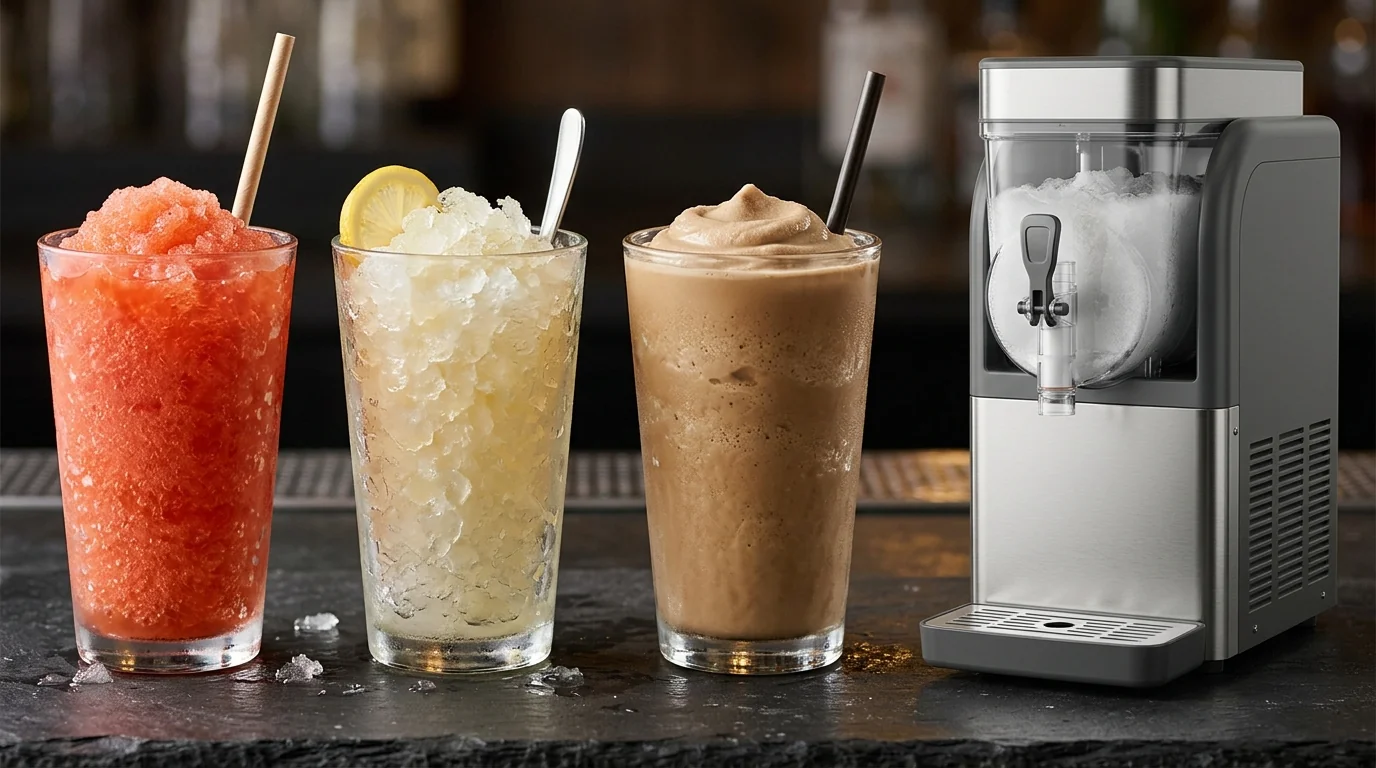
Side-by-Side Comparison: Classic Slush vs. Granita vs. Frozen Cocktails vs. Creamy Frozen Drinks
To help procurement teams and brand marketers match beverage applications to hardware capabilities across Crylivo's countertop slush and frozen drink machine collection, the table below compares the four main frozen beverage formats produced in auger-driven countertop tanks.
| Beverage Format | Base Formulation & Brix / ABV | Ice Crystal & Mouthfeel Profile | Serving Temperature Range | Primary Retail & Hospitality Positioning |
|---|---|---|---|---|
| Classic Fruit Slush / Slushy | Water + fruit syrup or juice (12-16 Brix sugar; 0% ABV) | Fine, uniform rounded ice micro-crystals suspended in syrup | Approx. -2°C to -3°C | Family home entertainment, convenience retail, cinemas, cafes |
| Italian Granita | Water + citrus/coffee/sugar (10-14 Brix; coarser crystal target) | Coarser, flaky crystalline grains eaten with a spoon or wide straw | Approx. -2°C to -4°C | European cafes, bakery-cafes, summer patio beverage programs |
| Frozen Margarita / Cocktail | Water + mixer + spirit (13-18 Brix sugar; controlled low-to-moderate ABV) | Smooth, dense slush suspension; alcohol lowers freezing point further | Approx. -4°C to -6°C | Home bar appliances, party hosts, poolside hospitality suites |
| Creamy Frozen Drink / Frappe | Dairy milk, plant milk, coffee, or cream base + sugar (14-18 Brix) | Velvety micro-crystalline or soft-frozen texture with emulsified fat | Approx. -3°C to -5°C | Coffee shops, dessert bars, 2-in-1 ice cream & slush appliance lines |
Note: Serving temperature ranges and recipe compatibility depend on the exact countertop machine model, temperature control presets, ambient temperature, and mixture formulation.
How Multi-Mode Countertop Machines Bridge Slush and Creamy Frozen Drinks
A single-temperature slush dispenser designed solely for convenience-store sugar syrups can struggle when a home user or cafe operator pours in a cold-brew latte mix or a citrus margarita base. That is why modern compact platforms in Crylivo's small cooling and frozen beverage appliance catalog increasingly use multi-mode electronic control boards—such as Crylivo's 1.8L 2-in-1 countertop ice cream and slush platform rated at 205W.
In slush mode, the controller maintains the evaporator cylinder within the narrow window required to form crisp, drinkable ice crystals from fruit juices and sodas in roughly 40 minutes. When switched to creamy frozen drink or soft ice cream mode, the system adjusts target cooling behavior and auger cycling to accommodate dairy fat, protein, and thicker viscosity without over-freezing the cylinder wall.
From a housing and hygiene perspective, combining ABS, food-contact PS, and SUS304 stainless steel allows a single compact 1.8L footprint to handle both clear fruit slushies and richer frozen drinks—provided the tank, auger, and tap assembly are designed for quick disassembly and thorough warm-water cleaning between dairy and non-dairy batches.
What Should B2B Buyers Verify When Sourcing Countertop Frozen Drink and Slush Machines?
When sourcing a countertop frozen drink machine for retail private label or hospitality distribution, evaluating the unit across multiple beverage recipes prevents post-launch customer complaints. Procurement teams collaborating with Crylivo's ISO 9001:2015 quality control and private label engineering system should test physical samples across both water-based slush mixes and thicker frozen beverage formulations.
Compliance documentation must also cover every material and electrical subsystem for the target region. Selected Crylivo 1.8L countertop slush platforms reference R290 hydrocarbon refrigerant, which should be verified under the U.S. EPA SNAP hydrocarbon refrigerant regulations or European F-gas standards. Because frozen drink machines process acidic juices, dairy mixes, and syrups, buyers should request model-specific food-contact test declarations under U.S. FDA 21 CFR food-contact material regulations or EU LFGB protocols, along with sanitation and electrical safety documentation referencing NSF food equipment sanitation standards where applicable and ETL or CE/RoHS electrical safety marks.
- Multi-Recipe Sample Testing (Slush, Cocktail & Dairy): Run 40-minute test batches using a 13 Brix fruit slush, a low-ABV margarita mix, and a dairy coffee frappe to verify texture consistency across all advertised modes.
- Dispensing Spigot and Seal Hygiene: Check that the front dispensing tap handles both thin crystalline slush and thicker creamy frozen drinks smoothly without dripping, and disassembles easily for cleaning.
- Compressor Wattage and Ambient Recovery: Verify the 205W rated input, air-cooled ventilation clearance, and R290 cooling stability under warm kitchen or patio ambient conditions.
- Keyword & Packaging Positioning by Market: Pair 'Countertop Slush Machine' with 'Frozen Drink & Margarita Maker' for North American retail packaging, and include 'Granita & Slush Machine' for European markets.
- Light Private Label Customization Scope: Align on logo printing, ABS/SUS304 housing colorways, multi-mode control panel graphics, recipe booklets, and drop-tested master cartons.
Frequently Asked Questions
Is a slush machine the same thing as a frozen drink machine?
Practically yes in countertop hardware: 'slush machine' and 'frozen drink machine' describe the same auger-driven freezing cylinder appliance. However, 'frozen drink' is a broader category term that also covers frozen cocktails, frappes, and dairy-based drinks when the machine offers multi-texture temperature modes.
Can a countertop slush machine make frozen margaritas and alcoholic slushies?
Yes, provided the alcohol content is balanced correctly. Because alcohol lowers the freezing point much faster than sugar, recipes should keep total mixture ABV low (typically under 5% to 7% in the final diluted pitcher) and maintain 13 to 18 Brix sugar so the batch freezes within the ~40-minute cycle.
How does Italian granita differ from a standard American slushy?
Both are made from water, sugar, and flavoring in a horizontal or vertical freezing cylinder, but granita uses slightly lower sugar concentration and slower agitation to form coarser, flakier ice crystals, whereas an American slushy uses higher Brix syrup for a smoother, finer straw-sipping texture.
Why do dairy-based frozen drinks require stricter cleaning routines than fruit slush?
Milk, cream, and plant-based dairy proteins can leave residue inside the dispensing tap and silicone gaskets if left overnight. Countertop machines used for creamy frozen drinks or 2-in-1 soft ice cream modes must have tool-free removable bowls, augers, and taps for daily warm-water sanitation.
How should B2B brands structure website pages for 'slush machine' vs. 'frozen drink machine'?
In Crylivo's page ownership map, the commercial Slush Machines category page owns both 'slush machine' and 'frozen drink machine' as primary and secondary head terms so traffic is consolidated on one strong commercial page, while educational articles target comparison queries like 'slush vs frozen drink.'
Source Countertop Slush and Frozen Drink Machines with Crylivo
Developing a countertop frozen beverage appliance line that serves fruit slushies, Italian granitas, frozen cocktails, and 2-in-1 soft frozen treats? Crylivo supports global B2B buyers with ready-to-market 1.8L countertop slush and frozen drink platforms, model-specific compliance documentation, and light private label customization. Reach out through the Crylivo B2B sourcing and sample inquiry page to discuss your target market, voltage requirements, and private label project scope.
Looking for the right ice maker for your market?
Tell us your ice type, capacity and target region. Our team will recommend the best platform from our OEM/ODM lineup.
Get a Quote →