Quick Answer: Sphere Ice vs. Cube Ice — Which Format Fits Your Product Line?
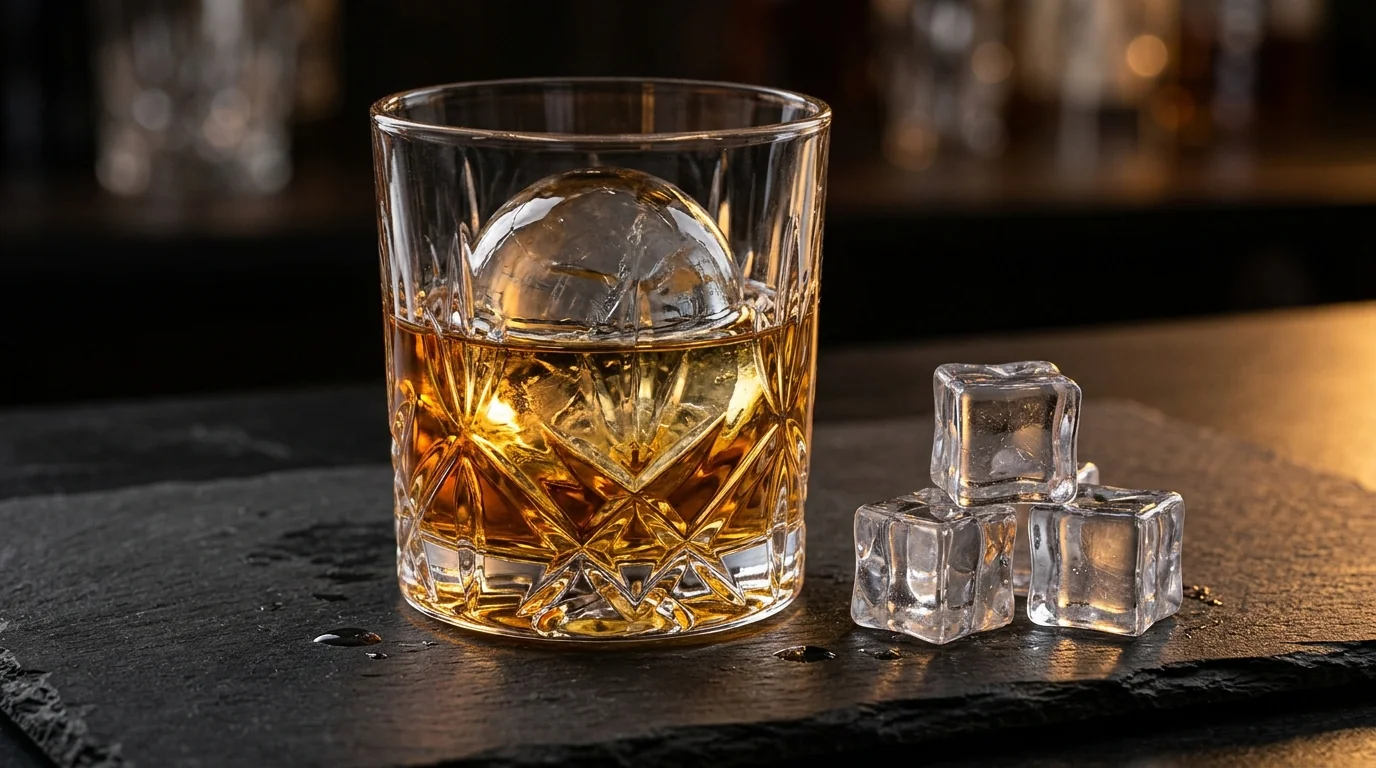
Sphere ice and cube ice serve two distinct beverage and commercial positioning roles. Sphere ice is formed in large 50mm to 55mm solid round balls with the lowest surface-area-to-volume ratio of any ice shape, melting slowly to preserve the proof and aroma of neat spirits, whiskey pours, and craft cocktails. Cube ice is formed in uniform square blocks (such as 20x20mm cubes) with higher batch output (24 cubes per ~14-minute cycle, up to 11.8 kg/24h reference output), making it the practical everyday workhorse for highballs, iced coffee, soft drinks, offices, and general hospitality service.
How Do Sphere Ice and Cube Ice Differ in Geometry, Surface Area, and Melt Physics?
The fundamental difference between sphere ice and cube ice lies in how three-dimensional geometry governs heat transfer between the liquid and the ice mass. When a beverage is poured into a glass, cooling happens rapidly during the first thirty to sixty seconds as thermal energy flows into the outer ice layer. Once the drink reaches equilibrium temperature, any further melting only adds unwanted water to the glass. Controlling that post-chilling melt rate is the primary reason hospitality operators and appliance brands separate round ice from square ice.
Mathematically, a sphere encloses the maximum volume of frozen water within the smallest possible external surface area. A single 55mm ice sphere contains roughly 87 cubic centimeters of ice while exposing only about 95 square centimeters of surface area to the surrounding spirit. By contrast, matching that same cooling mass with standard 20x20mm square cubes requires approximately eleven individual cubes, which expose more than 260 square centimeters of flat faces and sharp corners. Because sharp cube edges warm and erode fastest when agitated, square cubes chill tall mixed drinks rapidly whereas a single 50mm or 55mm sphere maintains a steady temperature with minimal dilution.
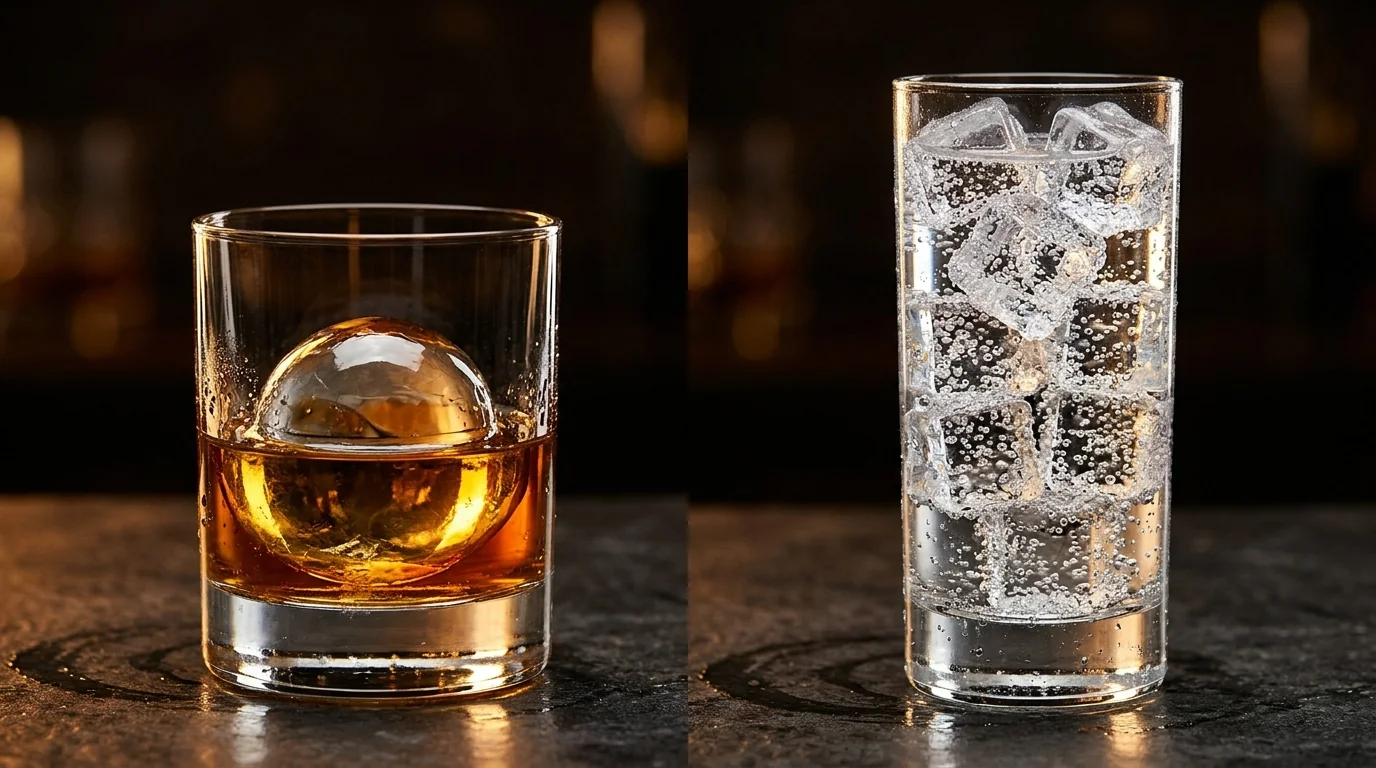
As explained in our foundational guide on what sphere ice is and how round ice geometry works, neither format replaces the other across a full beverage program. A whiskey lounge or home bar needs slow-melting 50mm to 55mm spheres for spirit-forward pours in lowball rocks glasses, while still relying on uniform square cubes for Collins glasses, shakers, and high-turnover cold drinks.
Sphere Ice vs. Cube Ice: Side-by-Side Technical and Commercial Comparison
For B2B appliance buyers, importers, and private label product managers, choosing between sphere and cube platforms requires comparing both the ice piece itself and the underlying countertop machine architecture. The table below summarizes the core structural, operational, and commercial tradeoffs between Crylivo's automatic countertop sphere ice makers and compact square cube ice makers.
| Evaluation Dimension | Sphere / Ball Ice Platform | Square Cube Ice Platform | B2B Product Line Implication |
|---|---|---|---|
| Ice Shape & Typical Size | Solid round sphere (50mm or 55mm diameter) | Uniform square cube (approx. 20x20mm) | Sphere targets spirit presentation; cube targets universal glass fit |
| Surface-to-Volume Ratio | Lowest possible (minimal exposed area per gram) | Moderate (six flat faces and eight corners per cube) | Sphere slows dilution; cube accelerates initial beverage chilling |
| Freezing Chamber Mechanism | Enclosed two-part hemispherical mold assembly | Multi-cell grid evaporator plate (24 cells per batch) | Sphere requires precision mold sealing and release control |
| Reference Cycle Time | 35-55 minutes per cycle (2 spheres per batch) | Approx. 14 minutes per cycle (24 cubes per batch) | Cube delivers faster first-batch turnaround for multi-user pantries |
| 24-Hour Reference Output | 42-72 pcs / 24h (model and ambient dependent) | Up to 11.8 kg / 24h reference output | Sphere is measured by piece count; cube is measured by daily weight |
| Water Tank Reference | 1.2L internal water reservoir | 1.6L internal water reservoir | Both run as self-contained countertop units without fixed drains |
| Primary Beverage Use Cases | Whiskey on the rocks, Old Fashioned, Negroni, craft cold brew | Highballs, iced Americano, soft drinks, cocktail shaking, water service | Complementary SKUs that rarely cannibalize the same buyer segment |
Note: Reference cycle times, piece counts, daily output weights, and tank volumes depend on the selected model, voltage version, ambient air temperature, and incoming water temperature.
How Do Countertop Sphere Ice Makers and Cube Ice Makers Differ Inside the Machine?
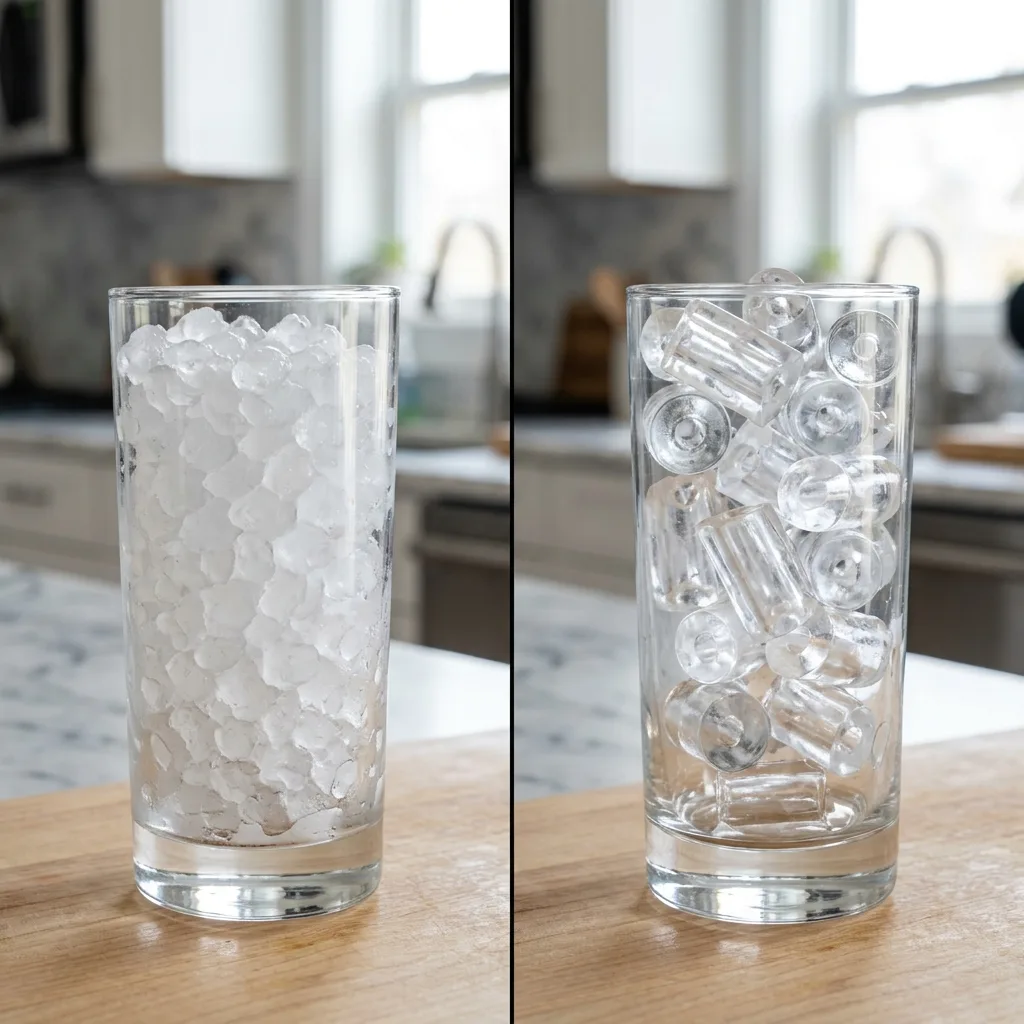
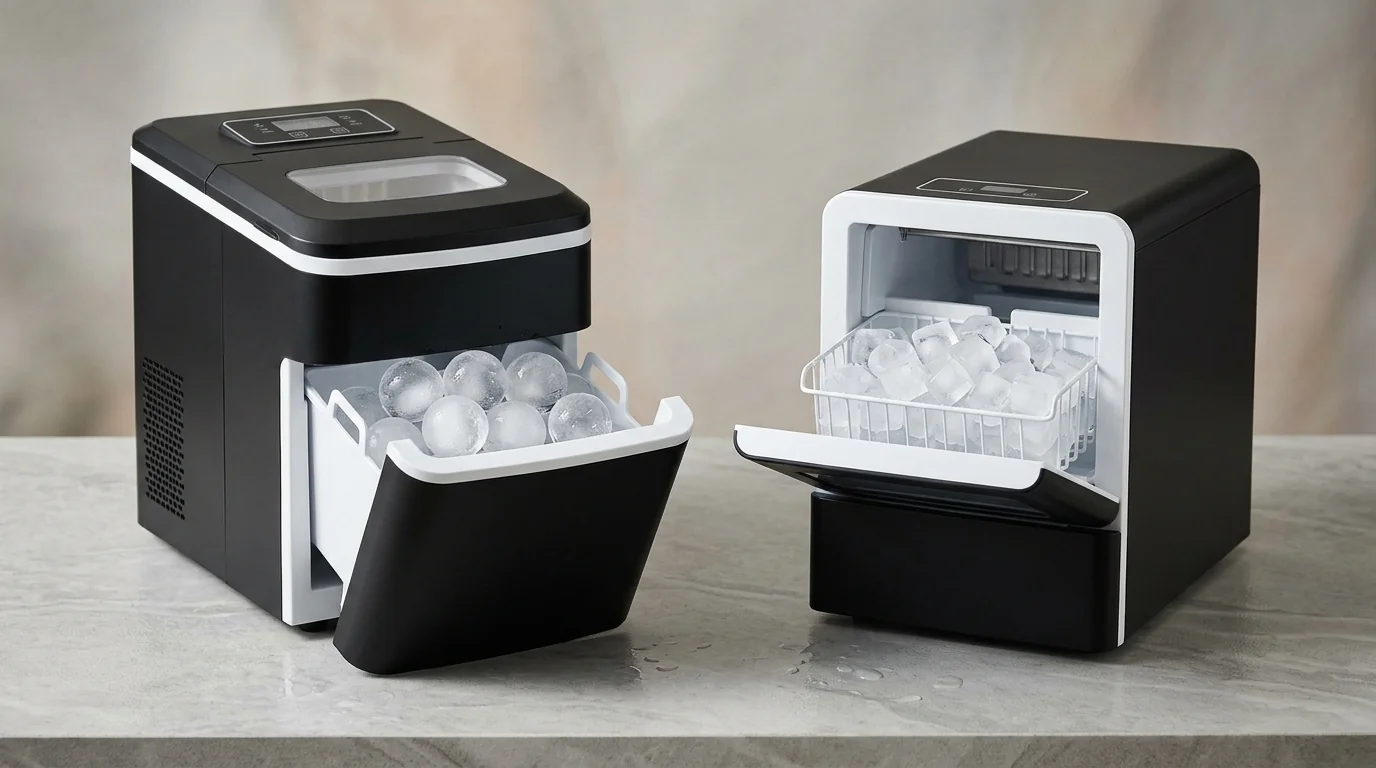
Beneath the outer housing, automatic sphere ice makers and square cube ice makers rely on fundamentally different evaporator and harvest structures. A compact countertop cube ice maker uses a multi-cell grid evaporator where water is circulated over twenty-four square cells simultaneously. Within roughly 14 minutes on reference platforms, twenty-four 20x20mm square cubes freeze solid, release cleanly during a brief harvest cycle, and drop into the storage basket to build up to 11.8 kg of daily ice supply.
An automatic countertop sphere ice maker, by contrast, is engineered around an enclosed two-cavity spherical mold assembly fed by a 1.2L water tank. Because freezing a solid 50mm or 55mm sphere from the outside in requires extracting heat through a thick cross-section of ice, each 2-piece batch takes approximately 35 to 55 minutes depending on model settings and room temperature. Selected Crylivo sphere platforms use high-efficiency air-cooled compressors referencing R290 refrigerant to maintain stable freezing temperatures across 42 to 72 spheres per 24 hours.
Because these two mechanisms serve different consumption rhythms, sourcing teams reviewing Crylivo's full countertop ice maker product catalog typically position cube machines for daily family, office pantry, and general foodservice demand, while positioning sphere machines as high-margin specialty appliances for home bars, executive lounges, and spirit gifting programs.
What Should B2B Buyers Check When Sourcing Sphere and Cube Ice Maker Lines?
When expanding a retail or hospitality appliance line to include both square cube and round sphere models, procurement teams must align specifications, compliance documents, and packaging standards before sample approval. Working through Crylivo's B2B manufacturing, quality control, and private label program allows importers to standardize artwork, manuals, and pre-shipment inspection routines across both product families.
Regulatory verification should always be scoped to the exact machine model and destination country. For models utilizing R290 hydrocarbon refrigerant, buyers should confirm charge limits and labeling under the U.S. EPA SNAP hydrocarbon refrigerant regulations or European F-gas directives. Internal water reservoirs, spherical molds, grid evaporators, and ice baskets should be backed by model-specific material test reports meeting U.S. FDA 21 CFR food-contact material standards or EU LFGB rules, alongside electrical safety marks such as the Intertek ETL Listed electrical safety mark for North American 110-120V/60Hz distribution or CE/RoHS compliance for 220-240V/50Hz European markets.
- Target Channel Segmentation: Position 20x20mm square cube ice makers as all-purpose beverage appliances for kitchens and offices, and position 50-55mm automatic sphere ice makers as premium barware and gifting SKUs.
- Capacity Metric Clarity on Packaging: State sphere machine output clearly in pieces per day (42-72 pcs/24h, 2 pcs per 35-55 min cycle) and cube machine output in weight per day (up to 11.8 kg/24h, 24 cubes per ~14 min cycle) so end users have accurate expectations.
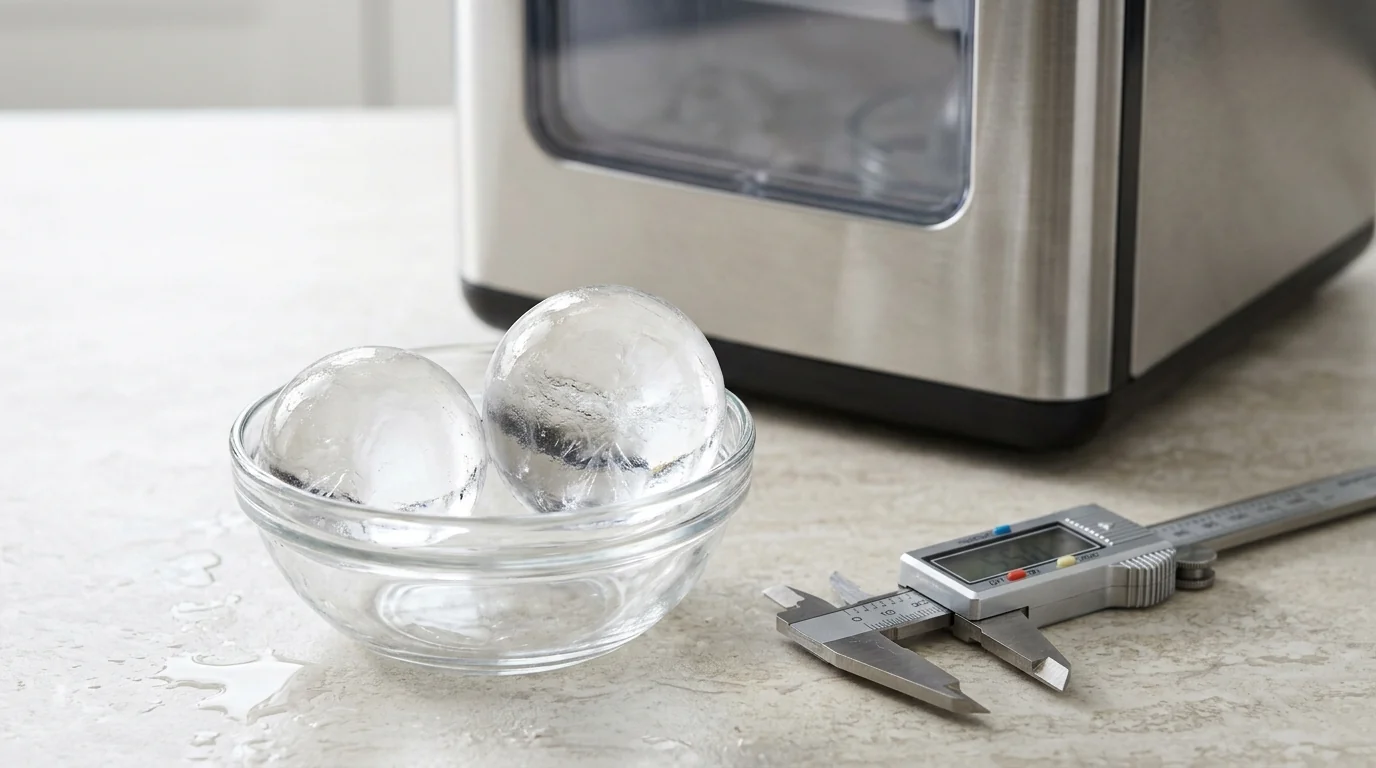
- Ice Piece Dimensional Inspection: Measure sample batches with calipers during trial runs to verify that 20x20mm cubes release cleanly without bridging and that 50mm or 55mm spheres form complete round contours.
- Voltage, Frequency, and Plug Localization: Confirm model-specific electrical configurations (110-120V/60Hz vs. 220-240V/50Hz) and cord plug types prior to mass production.
- Light Private Label Cohesion: Coordinate black-and-white or stainless housing finishes, silk-screened brand logos, control panel graphics, and drop-tested retail gift boxes across both SKUs.
Frequently Asked Questions
Does sphere ice chill a drink as fast as square cube ice?
No, a single 50mm or 55mm ice sphere chills a room-temperature drink slightly slower than a glass packed with 20x20mm square cubes because the cubes expose nearly three times more surface area. However, once the drink is chilled, the sphere melts much slower and prevents watery dilution.
Can a single countertop ice maker produce both 55mm spheres and 20x20mm square cubes?
No, automatic sphere ice makers and square cube ice makers use completely different internal evaporator and mold assemblies. Buyers who want to offer both formats typically source a dedicated countertop cube model alongside a dedicated automatic sphere model.
Why shouldn't bartenders use a 55mm ice sphere for cocktail shaking?
A single 50mm or 55mm sphere is too heavy and has too little surface area to aerate and chill a cocktail rapidly inside a tin shaker within ten to fifteen seconds. Standard 20x20mm square cubes provide the surface contact and agitation needed for shaking, while the sphere is placed in the serving glass afterward.
How should B2B brands prevent keyword cannibalization between sphere and cube product pages?
Assign 'ice cube maker' and 'square ice maker' exclusively to the cube category page, and assign 'automatic sphere ice maker' and 'ice ball maker machine' to the sphere category page. Use comparison articles like this guide to capture 'sphere ice vs cube ice' queries and funnel traffic to both commercial pages.
What customization options can buyers apply to both sphere and cube ice maker platforms?
Both platforms support light private label customization on ready-to-market tooling, including custom brand logos, coordinated housing colors, localized control panel overlays, custom retail color boxes, and market-specific user manuals confirmed by model and MOQ.
Compare Sphere and Cube Ice Maker Platforms with Crylivo
Building a differentiated countertop ice maker lineup that covers both everyday square cube service and premium slow-melting whiskey spheres? Crylivo helps appliance brands, importers, and hospitality distributors evaluate ready-to-market 20x20mm cube platforms and 50-55mm automatic sphere ice makers with coordinated private label branding and market-matched specifications. Contact our team via the Crylivo B2B product sourcing and sample inquiry page to request model datasheets, confirm voltage versions, and discuss your project volume.
Looking for the right ice maker for your market?
Tell us your ice type, capacity and target region. Our team will recommend the best platform from our OEM/ODM lineup.
Get a Quote →