Quick Answer: How Should Buyers Choose a Countertop Ice Maker?
To choose the right countertop ice maker, buyers should match five core specifications to their target user and sales channel: (1) Ice Format—bullet ice for affordable everyday chilling, chewable nugget ice for premium coffee and soda programs, 20x20mm square cubes for general hospitality, or 50-55mm spheres for home bars; (2) Real-World Capacity—balancing 24-hour production (typically 11.8kg to 15kg/24h, or 42-72 spheres/24h) against ice bin holding capacity (~800g) and water reservoir size (1.2L to 1.6L, plus optional 3L side tanks); (3) Housing & Ergonomics—stainless steel vs. ABS finishes, carry handles, and viewing windows; (4) Electrical & Market Compliance—110-120V/60Hz ETL vs. 220-240V/50Hz CE/LFGB; and (5) Private Label Readiness.
Step 1: Match the Countertop Ice Format to Your Target Customer and Beverage Use Case
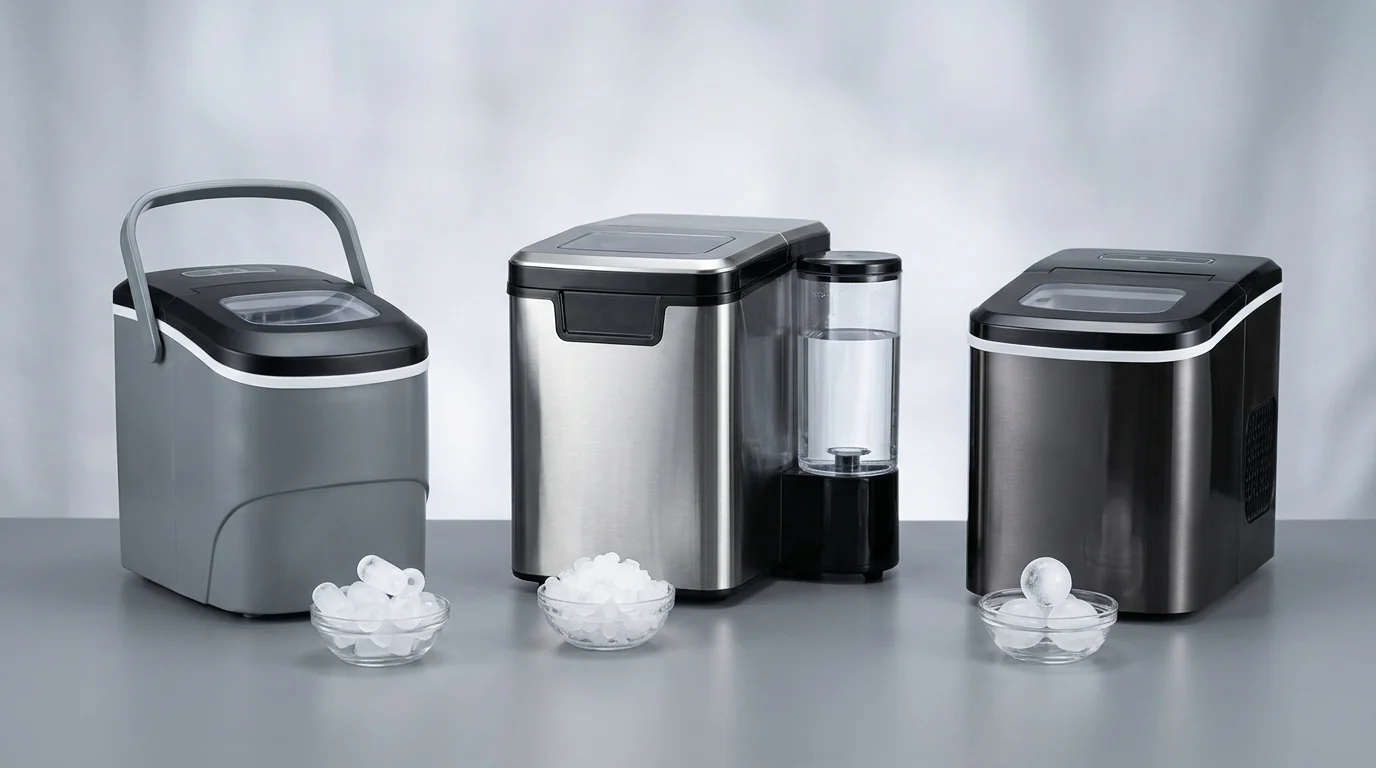
The single most important decision when selecting a compact ice maker is choosing the ice format, because the ice shape dictates the internal evaporator engineering, manufacturing cost tier, retail price point, and target consumer segment. Across Crylivo's countertop ice maker catalog, compact machines are organized into four distinct ice format families rather than treated as a single generic appliance.
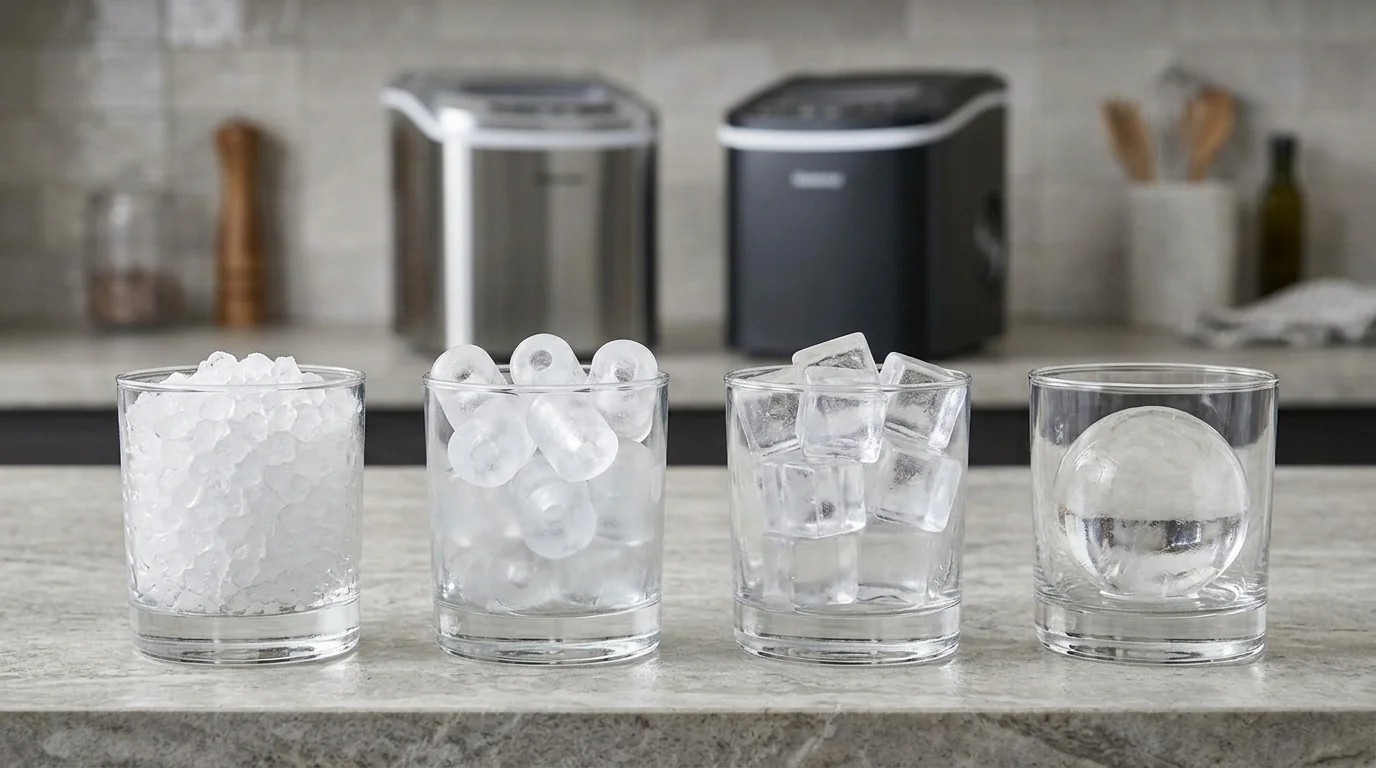
Bullet ice makers freeze water on cylindrical evaporator fingers to drop 9 hollow, rounded bullet-shaped pieces every 6 to 10 minutes (up to 15 kg / 33 lb per 24h reference output). Because evaporator-finger platforms are mechanically straightforward and compact, bullet ice makers serve as high-volume entry-to-mid retail workhorses for home kitchens, dorms, offices, and RVs. By contrast, models in Crylivo's countertop nugget ice maker series use an internal auger and cylinder system to extrude porous, chewable nugget ice (6-8 minute first ice, up to 15 kg/24h reference output), commanding higher retail margins among iced coffee, tea, and soft-drink enthusiasts.
Rounding out the four formats are square cube ice makers—which produce 24 uniform 20x20mm cubes per ~14-minute cycle (up to 11.8 kg/24h reference output) for classic beverage service—and automatic countertop sphere ice makers, which form 2 solid 50mm or 55mm whiskey ice balls every 35 to 55 minutes (42 to 72 spheres/24h) for specialty home bar and gifting programs.
Step 2: Evaluate Daily Output, Cycle Time, Water Tank Volume, and Bin Storage
A common mistake among first-time appliance buyers is looking only at the 24-hour headline production number (such as 12kg or 15kg per 24 hours) without checking cycle turnaround speed, water reservoir volume, and ice basket storage capacity. Because compact countertop ice makers are designed to be portable and plumbing-free, their removable storage bins are insulated to slow melting rather than acting as deep-freeze chests.
As a result, how quickly a machine produces its first batch (6-8 minutes on nugget platforms, 6-10 minutes on bullet platforms) and how much water its reservoir holds (1.2L to 1.6L internal tank, or an optional 3L side tank on selected nugget models) determine how smoothly the unit performs during peak afternoon or evening beverage service.
| Selection Dimension | Bullet Ice Platform | Nugget Ice Platform | Square Cube Platform | Sphere / Ball Platform |
|---|---|---|---|---|
| First Ice Cycle Time | 6-10 min (9 bullets/cycle; S/L size option) | 6-8 min first ice (continuous auger extrusion) | Approx. 14 min (24 square 20x20mm cubes) | 35-55 min (2 solid 50mm or 55mm spheres) |
| 24-Hour Reference Output | Up to 15 kg (33 lb) / 24h | Up to 15 kg (33 lb) / 24h | Up to 11.8 kg / 24h | 42-72 pcs / 24h |
| Water Reservoir Config | 1.5L internal water tank | 1.5L main tank (optional 3L side tank) | 1.6L internal water tank | 1.2L internal water tank |
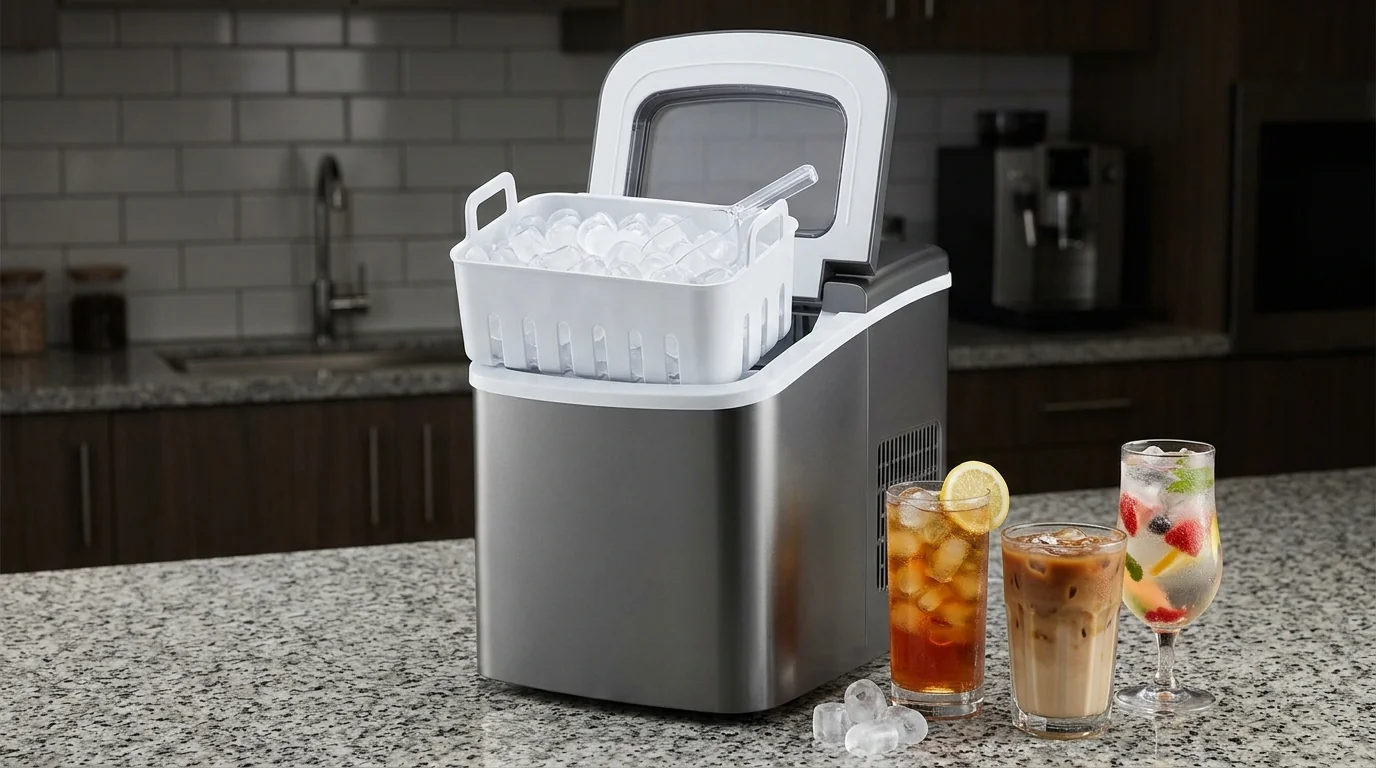
| Ice Basket Reference | Removable perforated basket + scoop | Approx. 800g (+/-10%) removable ice bin | Removable cube storage basket | Front pull-out insulated sphere drawer |
| Primary Channel Role | Entry/mid mass retail, RV, office pantry | Premium kitchen retail, coffee/soda bars | Classic home bar, office, daily cold drinks | Whiskey/cocktail gifting, executive lounges |
Note: All output, cycle time, tank, and bin figures represent Crylivo platform reference benchmarks and must be verified against the exact model specification sheet and sample test conditions.
Step 3: Compare Housing Materials, Portability Handles, and Control Interfaces
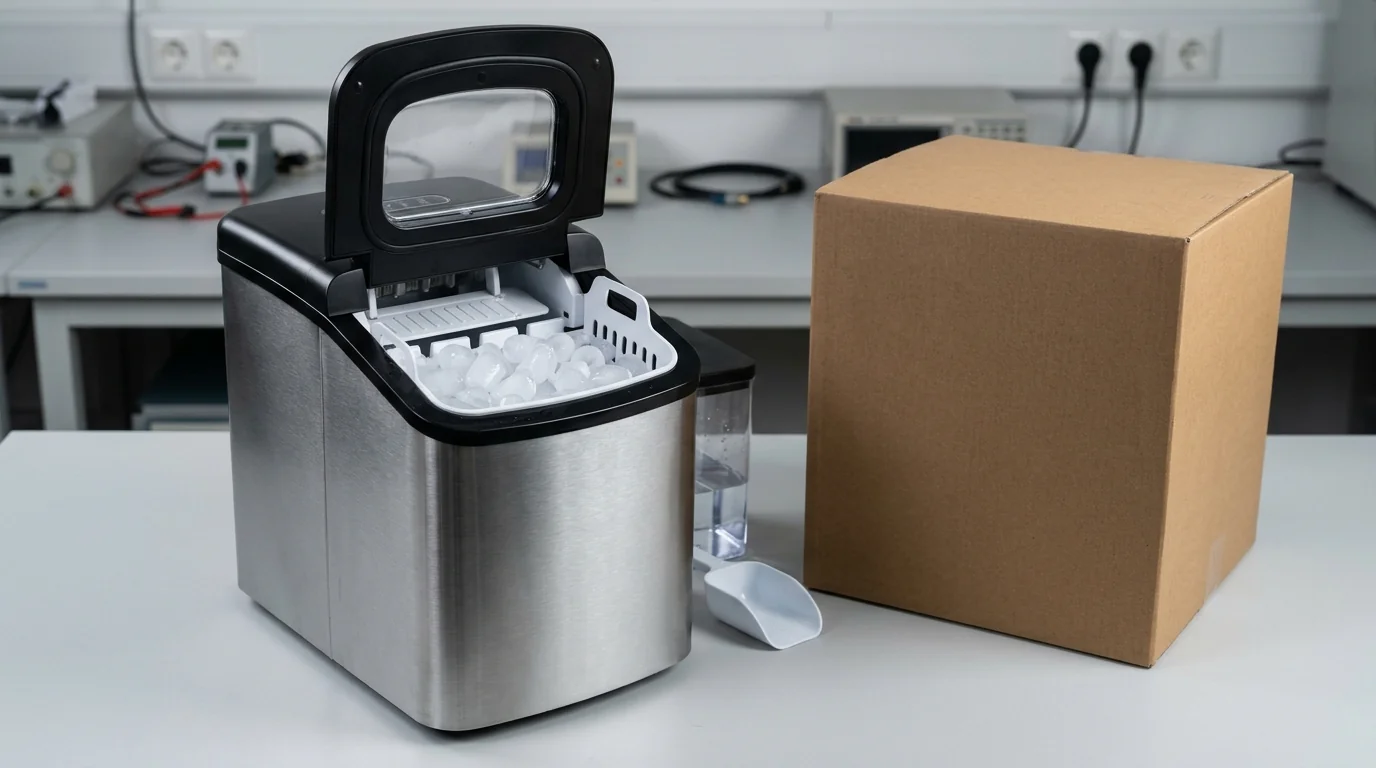
Once the internal ice-making platform is chosen, industrial design and housing materials differentiate a private label SKU on retail shelves and e-commerce product pages. Entry-level portable bullet ice makers often use lightweight molded ABS housings paired with a fold-down carry handle and a wide top viewing window, making them easy to move between kitchen counters, patios, and campers.
For mid-to-premium retail tiers, buyers frequently select brushed stainless steel or hybrid metal-and-matte-black housings—such as Crylivo's compact metal housing bullet ice maker (CRY-BIM-16M)—which coordinates with modern stainless kitchen appliances and offers enhanced cabinet rigidity. Buyers should also check control panel ergonomics, including angled LED touch or button interfaces, small/large ice size selectors on bullet units, one-touch cleaning cycle buttons, and clear 'Ice Full' and 'Add Water' indicator lights.
Step 4: Verify Target Market Voltage, Certifications, and Private Label Readiness
For B2B importers, distributors, and appliance brands, a countertop ice maker is only commercially viable if its electrical configuration, refrigerant documentation, and food-contact materials match the destination country's import regulations. Procurement teams working through Crylivo's ISO 9001:2015 quality control and OEM/private label system should verify compliance at the exact model level before placing trial orders.
In North America, buyers should confirm 110-120V/60Hz compressor specifications and electrical safety testing under the Intertek ETL Listed safety mark or UL 563 standards. For European Union and UK distribution, units require 220-240V/50Hz configurations supported by CE, CB, and RoHS documentation. Where platforms utilize hydrocarbon refrigerants such as R600a (isobutane) or R290 (propane), importers should verify compliance with the U.S. EPA SNAP hydrocarbon refrigerant rules or EU F-gas guidelines, and request model-specific food-contact test reports covering the water tank, ice basket, and scoop under U.S. FDA 21 CFR food-contact substance regulations or EU LFGB standards.
- 1. Define Ice Type & Price Tier: Select bullet ice for volume entry SKUs, nugget ice for high-demand chewable ice upgrades, cube ice for classic square service, or sphere ice for specialty barware.
- 2. Confirm Real-World Ambient Performance: Test physical samples at both standard room temperature (21°C/70°F) and warm summer kitchen conditions (30°C/86°F) to verify first-ice cycle times and 24-hour output.
- 3. Check Drainage, Cleaning & Acoustic Comfort: Inspect the bottom drain plug seal, self-cleaning circulation mode, and operating noise level during sample evaluation.
- 4. Lock In Model-Specific Compliance Dossiers: Verify ETL/CE electrical certificates, FDA/LFGB food-contact reports, and R600a/R290 refrigerant documentation for the exact model and voltage version.
- 5. Specify Light Private Label Customization: Confirm MOQ brackets (such as 100-300, 300-500, or 1,000+ pcs) for custom logos, housing colorways, control panel overlays, multilingual manuals, and drop-tested gift boxes.
Frequently Asked Questions
Which countertop ice maker type is best for a brand's first entry-level SKU?
A compact 12kg to 15kg portable bullet ice maker (with small/large bullet size selection, a 1.5L water tank, and a carry handle or metal housing) is typically the most versatile first SKU because it balances fast 6-10 minute cycles, broad household appeal, and accessible retail pricing.
Do countertop ice makers require a permanent water line or drain hookup?
Most compact countertop ice makers are designed to run without permanent plumbing. Users manually fill the internal 1.2L to 1.6L water reservoir (or 3L side tank on selected nugget models), and melted water from the ice basket drains back into the reservoir to be recycled into fresh ice.
How should buyers evaluate noise claims when comparing countertop ice makers?
Operating sound differs by mechanical architecture: bullet and cube ice makers primarily produce fan and compressor hum plus brief ice-drop sounds, whereas nugget ice makers also run a continuous gear-motor auger. Buyers should always evaluate acoustic performance during physical sample testing rather than relying on generic decibel claims.
What does the self-cleaning function on a countertop ice maker actually do?
A one-touch self-cleaning mode circulates water (and a mild descaling solution recommended in the manual) through the internal pump, water tube, and evaporator assembly for several minutes. Users still need to drain the reservoir afterward and wipe the removable ice basket and interior walls.
What should B2B buyers prepare before requesting a countertop ice maker quotation?
Buyers should specify their target destination market (voltage, frequency, and plug type), preferred ice format(s), estimated order quantity bracket, desired private label scope (logo, housing color, gift box artwork), and required compliance documentation.
Select Your Countertop Ice Maker Platform with Crylivo
Need help selecting the right countertop ice maker platforms for your retail brand, e-commerce catalog, or regional distribution program? Crylivo provides global B2B buyers with ready-to-market nugget, bullet, cube, and sphere ice makers backed by ISO 9001:2015 manufacturing and light private label customization. Reach out via the Crylivo B2B sourcing and sample inquiry page to compare model specifications, request samples, and discuss your target market requirements.
Looking for the right ice maker for your market?
Tell us your ice type, capacity and target region. Our team will recommend the best platform from our OEM/ODM lineup.
Get a Quote →